
Riding the Inaugural Race Across South Africa | By Greg Fisher

“I’m not a gravel racer.”
“I love the Freedom Challenge Support Stations and ice cream tubs.”
“The cut-offs are too tight.”
These were some of the excuses I made for myself to avoid signing up when I first heard about the inaugural Race Across South Africa (RASA), the GPS-navigated race along the Freedom Trail that would skip some of the most hectic bike-carrying portage sections.
Having done the traditional Freedom Challenge event twice before, I was wary of tackling the trail in this new format: starting with 45+ other riders; arranging all my own accommodation along the way; getting to Kranskop in 6 days and Bucklands in 10; riding long into the night; and sourcing food and other supplies from spaza shops. All these seemed like intimidating obstacles that would detract from my Freedom Challenge memories.
Yet at the same time, there was something intriguingly accessible and inviting about RASA: having a GPS line to follow at all times; not feeling locked into reaching or stopping at prespecified support stations; only being away from home for two weeks instead of three (in my case); not having to head down into Mordor or wait for an escort at the Baviaanskloof; discovering new towns along the route.
In early February, something tipped the scales, and I committed to RASA.
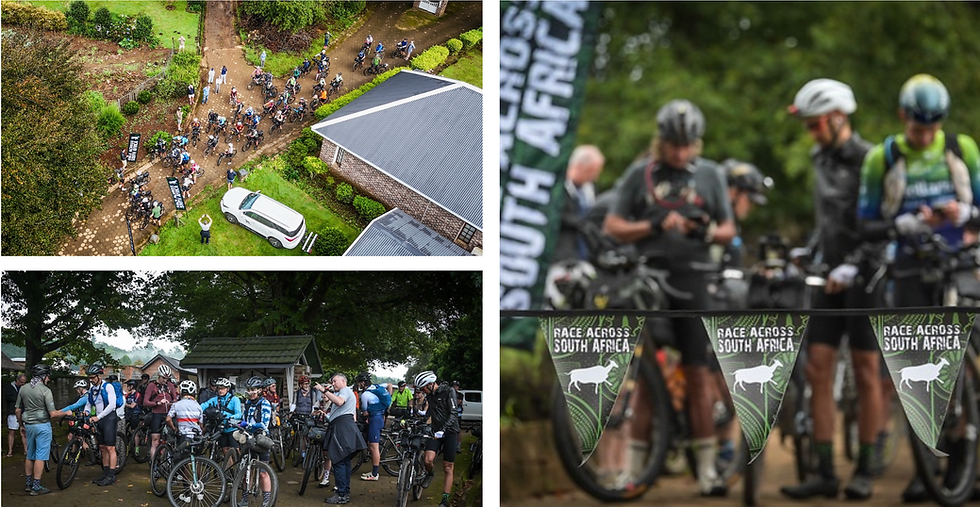
Three, four, five, six, and seven hours into day one of the race, I was deeply regretting that decision. Day 1 is brutal. There is no other way to put it. With 45+ people setting off together, the initial pace is testy, and the climbs on day one are extreme, not just the named, known climbs such as Hella Hella, the back of Centocow, and Ntsikeni, but also sneaky, unnamed climbs that keep coming throughout the day; they are relentless. For most Freedom Challenge riders, these climbs are split over the first two days of the ride to make them a little more palatable. But in RASA, because you start in Byrne and are under pressure to make up ground on day one, you end up climbing endlessly, and what’s more, the “Climb Pro” function on the GPS reminds you of this as one red section backs up into another red section, late into the evening. By the time we reached Dalu, at Ntsikeni at 10:00 pm, after a 15-hour day of riding, I was so shattered I could barely stomach any food. However, a hot shower and warm bed with the promise of 4 hours of blissful sleep before a 3 am wakeup call was enough to settle me.
Midway through Day 1, I paired up with Mike Woolnough, one of the most experienced Freedom Trail riders, and we rode together. Under ordinary circumstances, he would be way quicker than me, but he was using RASA as a way to regain fitness after having foot surgery. We ended up being very compatible riding partners and agreed to set off together at 4 am to start Day 2. With both of us having Freedom Challenge experience, we knew how tough the start to Day 2 would be – think grass, steep inclines, rutted roads, many gates and fences, and a notorious maize field riddled with black jacks, are all part of the equation in the escape from Ntsikeni to Two Springs. But it’s worth it. Two Springs Farm is an oasis after pushing, lifting, struggling, and fighting with one’s bike in the cold for four plus hours to cover 30km. The warm soup, fresh homemade bread, authentic butter, hot coffee, fried eggs, bacon, and Coke, all served around Caela’s dining table in her inviting home, make it easy to forget the tough early morning antics and provide excellent fuel for the 65 km push to Matatiele. We needed that fuel as Mike and I fought a headwind and splutters of rain as we pushed on to the Wimpy in Matatiele. Arriving at the Wimpy at 2:45 pm, we looked at each other, each of us thinking it would be great to pack it in for the day and sleep in Matatiele, but none of us was willing to say it. We were both tired, and we sat in silence, devouring a burger and milkshake. As we got up to leave, the heavens opened, and we promptly sat back down in the Wimpy and within 2 minutes, Mike’s head was on the table, and he was fast asleep. I wonder if we would ever leave. 20 minutes later, the rain had stopped, and the wind subsided; we reluctantly knew we had to get going. We did. It was hard, but we forced ourselves out and fought the horrid, rugged road surfaces for another 50+ kms to reach CP1 at Malekgolonyane. With 34 km to go, I recall Mike saying, “It’s just an easy weekend coffee ride to get to the checkpoint.” I thought to myself, this is going to be a very tough coffee ride. It was. With 12 km to go, I was breathing so heavily that Mike felt compelled to give me his asthma pump. It helped, and we rolled up to Malekgolonyane shortly after 8 pm, another 16-hour day in the books.

Although the original plan was to ride to Rhodes on Day 3, which would have been another 170km from CP1, we realized at CP1 that we needed some respite. We adjusted the plan to only go 80km to Vuvu the next day, a short day by RASA standards, allowing a bit of recovery and letting us tackle the notoriously steep and challenging section from Vuvu to Rhodes (including Mcambalala and Naude’s Nek) in the morning, when fresh. As with everything on the Freedom Trail, the 80km to Vuvu took longer and was harder than expected; it included basically circumventing the Vuvu Valley on a road, which is an interesting contrast to portaging straight up the valley in Freedom Challenge. We arrive at Vuvu school in the middle of the afternoon, just as the kids were leaving and their classrooms were being transformed into sleeping quarters. Following bucket showers, hot chocolate, and a meal of chicken and rice, more than 12 of us collapsed on mattresses under thick blankets in a school classroom to sleep for the evening. A few minutes after turning the lights off, the heavens opened, and it rained most of the night; the patter of raindrops was vividly loud on the tin school roof, and that, combined with the cacophony of snoring in the classroom, made sleep hard to come by. I lay awake thinking about those poor riders who had left Vuvu in the midafternoon, who were climbing to the highest point of the race at Naude’s Nek, and descending the steep roads into Rhodes in the pouring rain.
The rain mercifully stopped a few minutes before we set off at 2:30 am the following morning. Mike and I rode in silence in the pitch-black, early morning hours; we were both heading into the unknown, neither of us having tackled the Mcumbalala track before (the Lehana’s Pass hike-a-bike is the alternative typically used on the Freedom Challenge). Mcumbalala was a muddy mess; many times, it was hard to discern the steep track amidst the mud, mist, and dark; we took several wrong turns, even with the GPS to guide us. Both Mike and I struggled to see much through our fogged-up glasses. As we crested the initial ledge following a relentless, long, and muddy push-your-bike climb, the light was starting to emerge on the horizon. The worst is over, I told myself. After traversing a stunning plateau, we eventually came out on the Naude’s Nek pass road. It’s a genuinely beautiful pass, somewhat ridable on the lower slopes, but a good hike in the upper reaches. I decided to walk almost all of it to save my legs; every few hundred meters, I would stop, have a sip of Coke, look back, and just take in the beauty and expansiveness of the majestic Lesotho mountains. After what seemed like an age, four of us reached the top of the neck together. It was a small but meaningful victory, and we layered up to try and stay warm on the muddy, slippery descent into Rhodes. In Rhodes, we washed our bikes and ordered way too much pizza for lunch to fuel up for a rolling 60km afternoon ride to Barkley East. We arrived in Barkley East just as the sun was setting and made our way to find the simple room we had booked for the evening. There was no food at our accommodation, and the only thing we could easily and quickly source was chips and bread, so that sufficed for dinner.

By this time, Mike and I decided that one of the keys to succeeding at RASA was to start riding very, very early. Doing so allowed you to get a head start on the day and created valuable options later in the day. So, after another pre-8:00 pm bedtime, our alarm sounded at 1:45 am to get an early start. As we were about to leave at 2:30 am, a violent thunderstorm hit. We waited it out in the dining room of our accommodation and set out about 30 minutes later, trying to avoid the puddles left by the thunderstorm. The morning ride was an effort to stay awake; I downed Coke in the hope that the caffeine would kick in, and I think Mike had a “Regmaker” pill stashed away that he used to help him stay awake. We also layered down to feel a little chilly, in the hope that it would wake us. As we made our way toward Rossouw, Mike entertained me with stories about strange and friendly interactions in the largely forgotten Eastern Cape town, many of them involving the police station, spaza shop, and desperate Freedom Challenge riders. The hill out of Rossouw is a notorious grind that we both knew from the Freedom Challenge. We put our heads down and climbed it in silence, expectant for the long, flowing downhill toward Moordenaarspoort on the other side. By the time we reached the top of the climb, we could get a sense of how our day would pan out: we would reach Kranskop (CP2) in time for a late lunch, but too early to pack it in for the day; if we went onto Molteno, it would be a very late night. So we called Brosterlea Farm, midway between Kranskop and Molteno, to see if they could accommodate us for the night. This was one of the many instances in which knowledge from the Freedom Challenge about distances and trail locations paid off. We managed to reserve the only two available beds at Brosterlea, which were a lifesaver later that day when a huge electric storm rolled in. We reached Brosterlea just in time, and went to bed with rain, thunder, and lightning doing wild things outside.

The next morning was icy cold. It felt like winter Freedom events. Our hands, feet, and face were all frozen as we pedaled in the pre-dawn loneliness toward Molteno. The sun was rising behind us as the smell of baking rusks at the Molteno Ouma rusk factory hit our numb nostrils. In Molteno, we stoked up on Super-M’s, Lemon Creams, and Coke, and were peppered with curious questions by the manager of the local SPAR supermarket about this crazy race. Our provisions and the gradual climb out of Molteno warmed us up, as did the hearty welcome we got from Wil and Stephanie at Romansfontein Farm, as we stopped in for a full, cooked breakfast an hour after leaving Molteno. Romansfontein is a favourite Freedom Challenge support station, and they know exactly how to treat riders: warm coffee and tea; big portions of food; offers to tumble-dry wet clothes; and generous Eastern Cape hospitality. We stayed longer than we should have, just because it was nice. Setting back out, Mike and I had both decided today would likely be a shorter day; we would aim for the Hofmeyr Hotel. We sent a message to book a room. Following a long, slow, grinding, often frustrating climb and a rapid descent into the Karoo with 30km of fast, smooth dirt road riding, we reached Hofmeyr mid-afternoon. We could have gone on, but instead we ordered two huge pots of tea and sat on the veranda of Hofmeyr Hotel, in the sun, recounting events from the previous two days. I felt that our approach of two hard, long days, followed by an easier day, was serving us well on RASA. This was one of our easier days, and it even allowed us to get laundry done for the first time on the trail – a real luxury.

In fresh clothes and with full stomachs, we set off early again with the intention of arriving in Cradock at 8:00 am, just as the Wimpy opened. We timed it perfectly, and four of us fueled up on Wimpy breakfast and coffee for the long, beautiful, winding 14km long Swaershoek pass out of Cradock. It’s a stunning pass, and it had turned into a stunning day - windless, sunny, and warm. The four of us climbed the pass together, leapfrogging each other, and occasionally, being distracted by the race photographer's drone capturing the moment for posterity. What goes up must come down, and the descent on the other side was rapid. Mike and I descended fast, but we weren’t racing. The other two riders, Giles and Rob, had grander plans for the day, and they raced ahead while Mike and I lay in the grass, under the trees in the valley, appreciating the privilege of being on the trail. Mike was also dealing with some issues back home and had to decide whether staying on the trail was a wise or fair decision. The climb over the Pearston Pass, into the Karoo town of Pearston, was uneventful; however, while at the Pearston Hotel, Mike decided he needed to return home for family reasons. He had been getting stronger and stronger all week, and I could tell his heart desperately wanted to continue toward Wellington, but his head told him he needed to be back in Johannesburg.

So after a fitful night’s sleep in the less-than-desirable Pearston Hotel, I said my final goodbye to Mike and set off on my own in the very early hours of Monday morning. While riding through the pitch black of the very early morning, with only a single stream of light from my headlamp to guide me, I came up with the concept of the “BS50”: Before Sunrise 50km. It was something that we did many days on the trail, covering more than 50km even before the sun came up. In most other circumstances that would seem absurd, but on RASA, it was becoming the norm. Riding alone, pretty much for the first time in the race, I thought about a lot that morning. I thought about how much I had learned from Mike over the past seven days, and how efficiently we had moved down the trail together. I thought about my own family, and about how special, unique, inspiring, and challenging this race was. How it was different from the Freedom Challenge in an interesting way: more flexibility, more pressure to keep moving, and more self-sustaining. I saw giraffe, gemsbok, warthog, and countless birds as I peddled between two mountain ranges across the expanse of the Karoo. I kept looking over my shoulder, expecting the other riders who had also stayed over at the Pearston hotel to catch me. They never did. I enjoyed lunch-for-one on the stoep, out of the wind, at the Kleinpoort Padstaal: a chicken burger, chips, and a double-thick vanilla milkshake. Then I set off to cover the final 30 kms of the day (in self-imposed 10km increments to make it manageable), into the wind, to CP3 at Bucklands guest farm, where I was greeted by enthusiastic Buffalo Herders: Mike Roy and Andrew Cromhout. Buffalo Herders, the affectionate name for Freedom Trail volunteers, are the bomb. They help in whatever way they can: food, drink, lifting one’s spirits, sharing stories from the trail, not letting you pull out for non-valid reasons, and even bike help (if you are willing to accept the associated time penalty).
I escaped Bucklands early with three other riders: Merak and Ollie Greaves, and Ingrid Avidon. We hoped to reach Steytlerville, 50km away, just in time for a morning cup of coffee. Unfortunately, only the spaza shops were open in Steytlerville when we got there, so instead of breakfast and coffee, I sat in the sun centre median of the road (the only place where the sun was shining at that time) and ate an entire tube of Oreos (14 Oreo cookies), while sipping on a chocolate Steri Stumpie – this was trail life. As we left Steytlerville, the wind was picking up and would be our mortal enemy for the rest of the day. A block headwind, from Steytlerville to Willowmore. No let-up. Every kilometer earned. A hard, hard day. The “fold mountain” scenery on either side of us was stunning, but the riding was extremely tough. I went to bed that night at the Willow Guesthouse still feeling the unrelenting wind in my face.
The following day, on the road between Willowmore and Prince Albert, I decided it was in my best interest to ride alone, at my own pace, rather than trying to keep up with or match the pace of the other riders in the race nearby. Just a slight increase in pace was pushing me over some threshold, and I sensed I might blow up. Releasing myself from the shackles and stress of trying to ride with others was extremely liberating. I moved along the trail at my pace and rolled into Prince Albert in the mid-afternoon, after greeting several people on the run into town who had come out to ‘watch the race’ and welcome riders. Prince Albert has many accommodation options, and the Greaves and I found a special one – a traditional Karoo cottage, furnished with antique furniture, just off the main street, allowing us to walk less than 100m to a great restaurant for a dinner of venison pie, mashed potatoes, and vegetables. Delicious!
The following day, we tackled the Swartberg Pass in the early morning darkness. I got a slight head start on the others, leaving Prince Albert, knowing they would likely catch me up on the pass or on the descent on the other side. The climb up was tough, but fine, just as expected. The wind chill on the descent down the other side was hypothermic. Even though I had layered up with almost all the clothing I was carrying, put on my winter gloves, and thick woolen socks, I still could not take it. Multiple times, I had to stop while descending and just try to regain a little warmth by jumping around or rubbing my hands and face before moving again. Eventually, I found three locals who had started a small fire on the side of the road, and I joined them around it for some respite from the cold. The other riders caught up with me while I was sitting by the fire, and we then all soldiered on together, willing the sun to come up and hit our backs. After a short while, the group splintered, and I ended up riding the rest of the day alone, somewhat to my relief. Down the valley into Calitzdorp, over the impressive and challenging Rooiberg Pass, through Vanwyksdorp, where I shopped at ‘The Mall’ – an eclectic shop selling second-hand coats, headlights, radios, samosas, cool drinks, and fruit. The road from Vanwyksdorp to Ladismith dragged on forever, and by the time Ana from the Karoocible Guest House in Ladismith jumped out to greet me, I had notched up my longest day on the trail to date: 185 km. Six of us were staying at Karoocible Guest House, and we were graciously and enthusiastically hosted by Ana and Pete – they cooked up a chicken potjie, rice and salad, set the table, and hauled out a stash of snacks left over from a recent cycle tour that they put on. They could not have been more welcoming and accommodating, and, as cyclists themselves, they were clearly thrilled to host RASA riders.

While the prior day had been the longest ride on the trail to date, my second-to-last day on the trail would need to be even longer: Ladismith to McGregor: 190km. Luckily, the first 35km are essentially downhill on a tar road: “free kilometers” as Ollie called them. As the sun was rising, we entered Anysberg Nature Reserve, set in a stunning, remote valley. A gradual climb took us up to the nature reserve office, where we could refill our water and eat the sandwiches Ana had made for us. Then a fun descent carried us out of the reserve and to the foot of the Ouberg Pass, a nasty little pass with a massive 30km+ descent into Montagu on the other side. I love that descent, there is so much of it, and it takes you through a beautiful, partially cultivated valley. I arrived in Montagu at the same time as Ollie and Merak, and we enjoyed a fancy lunch together, under the trees, at one of Montagu’s many well-to-do eating establishments. It was enough to fuel us for the mixed terrain ride connecting Montagu to McGregor – some tar, some dirt roads, a few climbs, and some jeep track as you enter McGregor. McGregor Backpackers is another Freedom Challenge favourite support station, and I pulled up to spend my final night on the trail amidst the Geoff Botten hospitality. A few other riders were also there: the Greaves, Rob and Giles, and Ingrid, contemplating whether to make a final push to the finish through the night.
The guys all awoke the following morning to discover that Ingrid had, in fact, ‘flown the coop’ in the middle of the night. My phone pinged at 8:30 am that morning with a WhatsApp message announcing Ingrid’s arrival at the finish. I calculated that she must have left McGregor Backpackers at about 10 pm – brave, crazy woman! While the other guys who left McGregor Backpackers at the same time as me all raced to finish, I stalled and deliberately moved slowly to reach the finish. My family was flying in from Johannesburg that day, but their plane landed at 1:30 pm, so the earliest they would be at the finish at Diemersfontein was 3:00 pm. I could not reach the finish before then. This resulted in a leisurely but stunningly beautiful climb up the smooth road of the Bains Kloof Pass, and a 45-minute nap at the top to give my family enough time to reach the finish. Thereafter, I mounted my bike and joyfully descended the pass, with a strong sense of accomplishment for what I had achieved, a sense of astonishment, and wonder for what I had seen crossing the country on a bicycle, and a sense of appreciation for having the opportunity to be part of the inaugural version of this incredible event.

“It’s not just for gravel racers.”
“I still got to enjoy some of the Freedom Challenge Support Stations and discover new spots along the way.”
“The cut-offs are manageable, especially if you’re willing to get going early,” I decided.
RASA is for me, and for many others.

A mate of mine shared no deposit bonus with me after a really messy breakup, mostly just to get my mind off things. One night when I couldn't sleep for the life of me, I decided to take a look and was genuinely surprised by how chill the atmosphere was—not loud or intrusive at all. I poured myself a drink, got comfortable, and finally felt my head settle after weeks of tension. I ended the night having a proper yarn with someone new and everything just flowed. It was exactly the kind of mental reset I needed.
While exploring different online platforms related to digital entertainment for South African users, I came across watch here and spent some time browsing its informational and comparison sections. The site appeared fairly structured, with content organized into clear categories that made navigation between topics relatively straightforward. I also noticed that many explanations were written in a simple and accessible style, focusing on general descriptions of features and platform comparisons rather than overly technical detail. The layout allowed for smooth browsing between pages, which made it easier to review information in a more structured way without feeling overwhelmed. Overall, the experience felt clear and easy to follow for casual readers interested in this type of content.